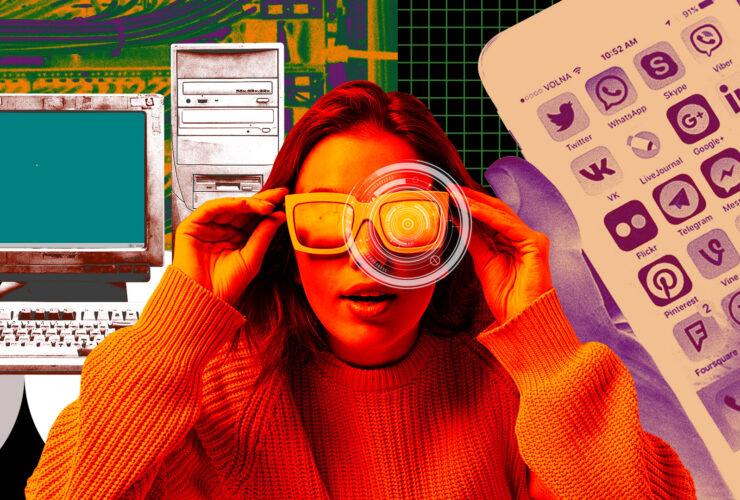
The internet has become a part of life that can never be separated from our daily lives. Try to remember, how much time do we spend in one day staring at a cellphone or computer screen? Based on data from the Digital 2022 April Global Statshot Report released by We Are Social and Hootsuite, the average person in the world spends 413 minutes or almost seven hours a day accessing the internet. Maybe even the younger generation such as Gen Z or Gen Alpha can spend even more time than just seven hours.
It is amazing if we look at the development of the internet from the 90s to the present which feels so rapid. Do you still remember how noisy the sound of the modem that we needed to turn on to be able to connect to the internet in the past? Or do you still remember how long you needed to spend just to download a document? With the development of the internet, now everything is present instantly and without hassle.
Let me take you back a few decades to the present day and get to know the beginnings of the internet – or what we can call web 1.0. Although computer networking technology has actually been around since the 1960s, the internet was only commercialized for the public in the 90s – that’s when our information technology revolution began. In the web 1.0 era, the internet was mostly filled with static websites owned by companies and there was almost no interaction between users or what is known as read only web. At that time, the internet function was more used to search for information or as a reference source.
The demands from users to be able to interact more with information on the internet ultimately led to the development of web 2.0 which was marked by the emergence of user generated content such as blogs and eventually developed into social media. This internet transformation began in 2004 and is still ongoing today. Web 2.0 has more interactive and participatory characteristics where the way we access information has changed to two-way and we can enrich the content of a site or web media. If previously the internet was read only, in this era the internet has become read write.
In this era of web 2.0, companies are not only providing content for users, but they are also starting to provide platforms - in the form of sites or applications - that users can use to share content and engage in user-to-user interactions. It is also in this era that technology companies are starting to have a big influence in society because they can control the value generated by a platform which ultimately leads to a centralized internet system where everything is controlled by big technology companies.
In web 2.0, big technology companies also get a lot of attention because they are considered to be monopolizing internet services. For example, when we as social media users upload photos. Although the photos we have uploaded are our personal photos, when they are on the media, the ownership of the assets is not ours but belongs to the technology company. It can be said that we do not have any assets on the internet because of this centralization. Departing from this problem, movements have emerged that want the latest revolution in the internet world, thus creating the latest developments towards the third generation or web 3.0.
Web 3.0 will address the issues of centralization and monopoly of big tech companies because this latest web system will be built on a blockchain network that makes data hosting distributed and control over the platform is returned to the user. In short: decentralization.
Furthermore, web 3.0 will also be supported by metaverse as the latest internet platform. Metaverse is seen as an evolution of the way or medium for us to enjoy content. If we remember the history of how we can access content, it all started with television which then developed into new mediums such as computers and smartphones. The content presented has also developed; starting from one-way content displayed by television to interactive content on computers and cellphones. Metaverse and web 3.0 will change everything. Interactivity will be more immersive and the appearance presented will change from two dimensions to three dimensions. This is what is called frameless future or a frameless future where the boundaries between us as users and information as content disappear.
We ourselves at WIR Group have built the infrastructure towards frameless future for 12 years by focusing on the development of Augmented Reality (AR), Virtual Reality (VR), Artificial Intelligence (AI) and metaverse which is a future internet interaction in 3D. Maybe you will ask: "Why is the future in three-dimensional content?" Studies say that the human eye is accustomed to everything that is real or tangible so that in the future consumers or internet users will always demand content to be present in three dimensions.
The journey to the perfect web 3.0 and metaverse is still long. But I am sure we can achieve it soon. It takes patience and contribution from all parties including academics, businesses, communities, governments, media, and the entire society to make it happen. So, are you ready to enter the new era?